
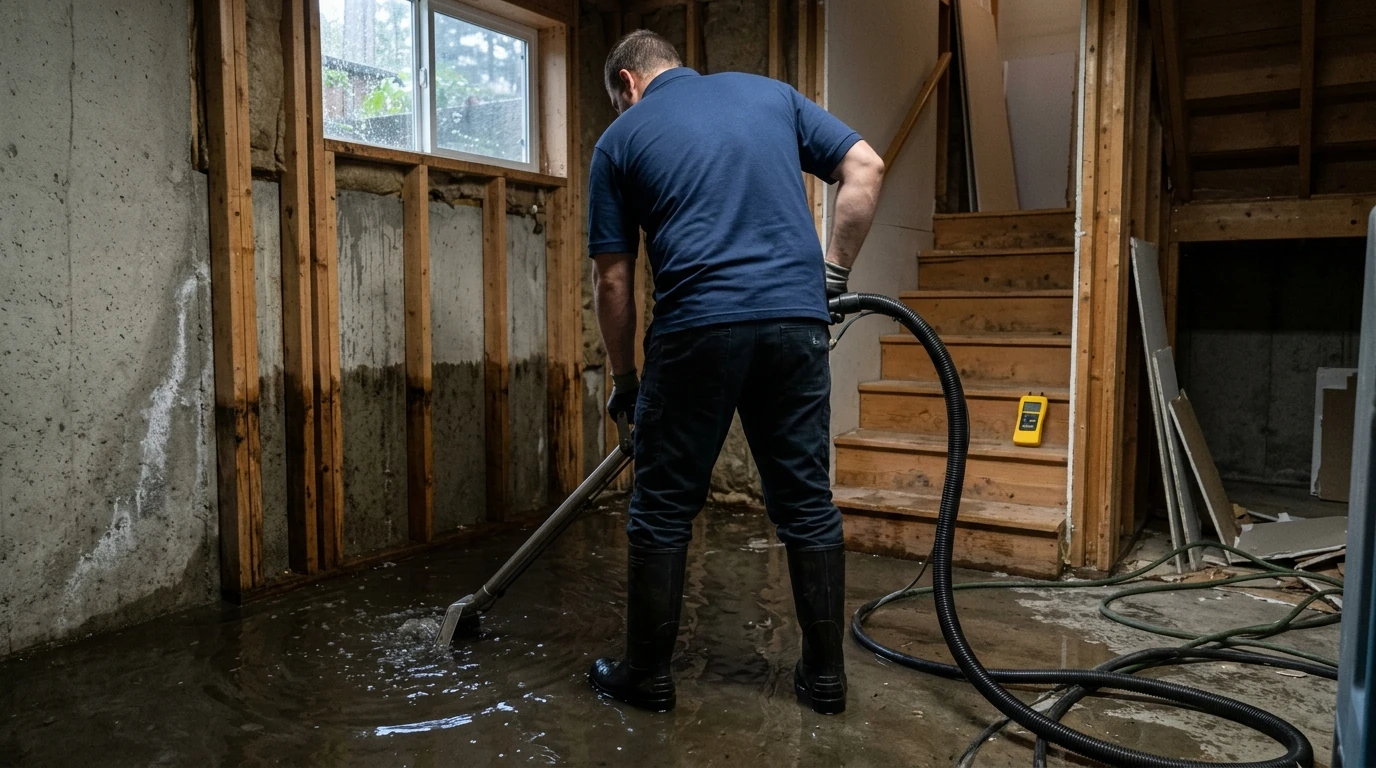
If you’re standing at the top of your basement stairs in Tacoma looking at water on the floor, call Frontline Fire & Flood for emergency water removal and basement flooding cleanup. The company holds an IICRC Certified Firm designation, runs on a 24/7 line, and carries a 4.9 rating across 137 Google reviews. Before you call anyone, though, there are two things to do in the next five minutes that protect you and the house.
What Do You Do First, Before Anyone Arrives?
Shut off power to the flooded area at the breaker panel if you can reach it without stepping into standing water, and stop the source of the water if it’s safe to identify.
In Tacoma’s North End and South Tacoma neighborhoods, a lot of the housing stock has daylight or partial basements built decades ago, with sump pumps, foundation drains, and supply lines that were never rated for today’s storm volume. If the water is coming from a supply line or water heater, find the shutoff valve and close it. If it’s rising up through the floor drain or around the foundation, that’s not something a valve fixes. Don’t go down exterior basement stairs or touch anything electrical if the water is more than ankle-deep. Move anything you can lift off the floor, and start taking photos before you touch anything else. Those photos matter later for your insurance file.
Plumber or Water Damage Restoration Company: Who Do You Call First?
Call a plumber first only if the water is actively flowing from a pipe, fixture, or appliance you can’t shut off yourself. For almost everything else, including standing water, groundwater seepage, or a sump pump that’s already failed, call a restoration company directly.
A plumber’s job is fixing the mechanical failure: the burst line, the dead sump pump, the failed check valve. A restoration company handles what’s already on the floor, the materials it’s soaked into, and the insurance paperwork that follows. If the two overlap (a failed sump pump that’s still pushing water), a restoration crew like Frontline Fire & Flood can usually start extraction while coordinating a plumber for the mechanical repair, so you’re not waiting on two separate dispatches. If there’s a live electrical hazard, a gas smell, or structural concern, that’s a call to the utility company or 911 first, full stop. Hold off on calling your insurance company until the water is stopped and extraction has started. Adjusters want to see mitigation already underway, not a call placed while water is still rising.
Is the Water Clean, Gray, or Sewage?
The source tells you the category, and the category determines how the cleanup has to be handled. This isn’t a judgment call you want to guess on.
Water from a clean supply line or a water heater starts as Category 1, but it doesn’t stay clean once it sits on a basement floor or soaks into drywall and carpet pad for more than a few hours. Groundwater pushing in through foundation cracks or a window well, which is common in Tacoma basements during a wet fall and winter with high water tables, is Category 2 (gray water): it’s carrying soil, organic matter, and enough contamination that it changes how materials get handled. Anything backing up through a floor drain or toilet from beyond the trap is Category 3 (black water, often sewage) and needs antimicrobial treatment, PPE, and in most cases the removal of porous materials like carpet pad and drywall rather than drying them in place. If you’re not sure which one you’re looking at, that uncertainty alone is a reason to get a professional assessment instead of guessing with a shop vac. For the mechanics of how categories are defined, the IICRC S500 standard is the industry reference restoration crews are trained against.
If the water is coming up through a drain rather than down from a pipe, see our breakdown on sewage backup response in Tacoma for what changes when it’s Category 3.
What Happens When You Call a Restoration Company?
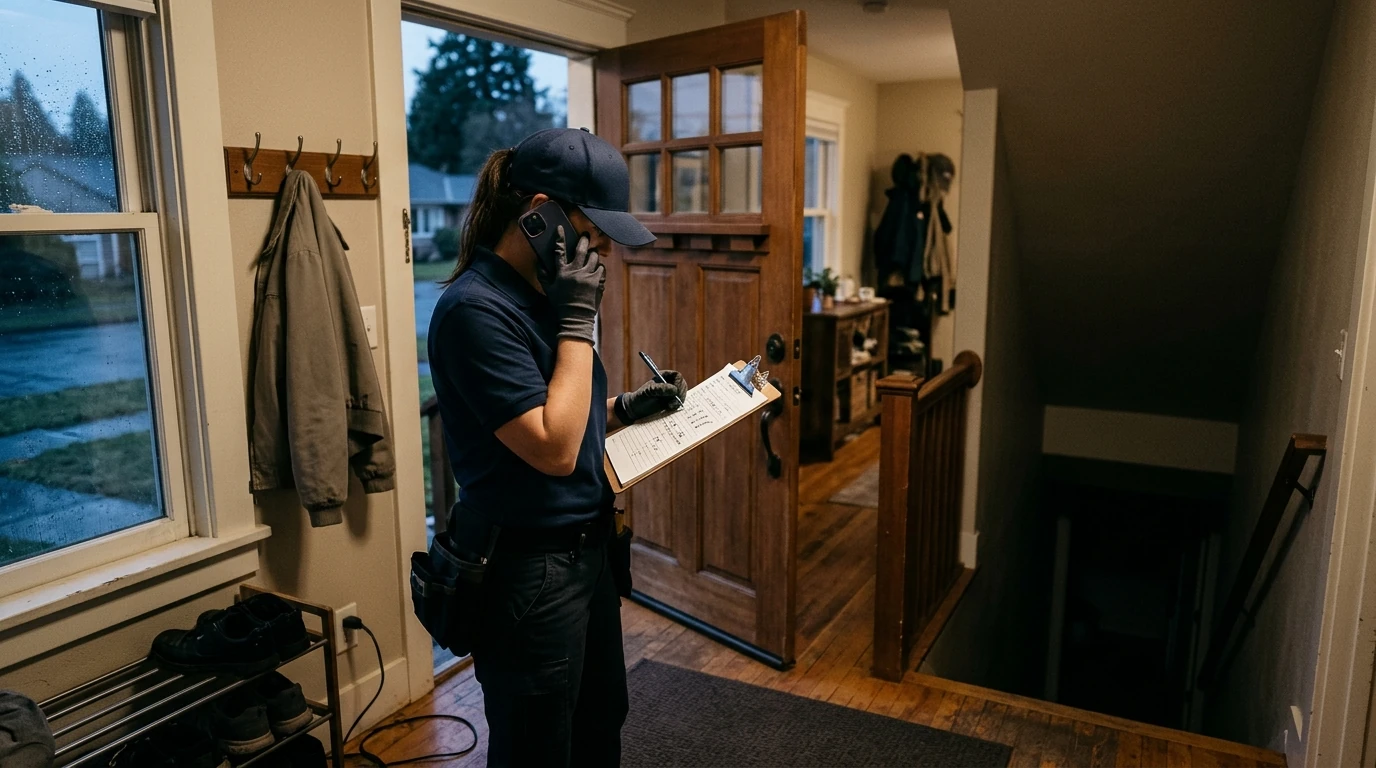
A real intake call gets a few specifics upfront: the water source if known, how long it’s been standing, square footage affected, and whether power is still on in the area. From there, a crew mobilizes with extraction equipment and documents the scene before anything is moved.
On arrival, the first steps are usually the same regardless of category: confirm the source is stopped, extract standing water with truck-mounted or portable pumps, and take moisture readings on framing, subfloor, and drywall to map how far the water traveled. In a daylight basement with exposed studs, that waterline is often easy to see and photograph, which helps both the drying plan and your claim file. Air movers and low-grain-refrigerant dehumidifiers go in next to bring the space down to a dry standard, not just a dry-feeling one. Depending on category and how long materials sat wet, some drywall, baseboard, and flooring may need to come out rather than dry in place. For the broader version of this process across water damage generally (not just basements), see our guide to who to call for water damage restoration in Tacoma.
Will Homeowners Insurance Cover a Flooded Basement in Washington?
Most standard homeowners policies cover sudden water damage from inside the home, like a burst pipe, but they do not automatically cover flood, sump pump failure, or sewer backup.
If your basement flooded because of rising groundwater, surface water, or a river or creek overflowing, that’s a flood claim, and a standard homeowners policy excludes it; you’d need a separate flood policy through the NFIP or a private flood carrier. If the water came from your own sump pump failing or a sewer line backing up, that’s only covered if you added a water backup (sewer/sump) endorsement to your policy before the loss, something a lot of homeowners find out they don’t have after the fact. Coverage details vary by insurer and by policy, so check your declarations page or call your agent directly, and the Washington Office of the Insurance Commissioner is a reliable place to look up how state rules apply to your specific carrier. Document everything with photos and keep any receipts for emergency mitigation; most policies require you to limit further damage, and a documented, prompt response supports that.
If the pipe itself failed rather than the basement flooding from outside, the steps diverge a bit, see burst pipe in Tacoma: who to call first for that specific scenario.
A flooded basement rarely waits for business hours, and the longer standing water sits against drywall, framing, or stored belongings, the more of it has to be removed rather than saved. Request a basement flooding assessment from Frontline Fire & Flood, or see the emergency water removal page for what’s included in an initial callout.
Need help now? Call Frontline Fire & Flood at (253) 200-0503.