
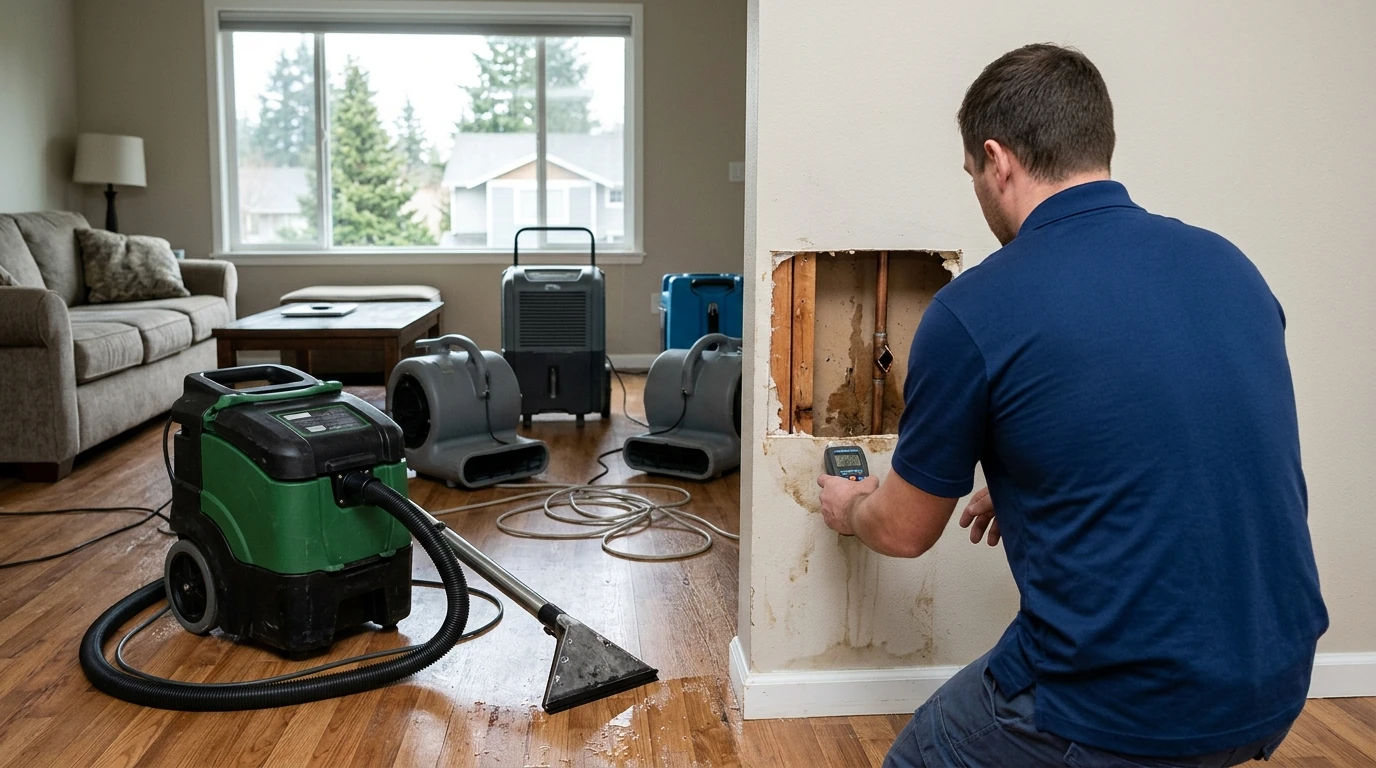
If a pipe just split open in your Tacoma home, you need two different calls, not one: a licensed plumber to physically stop the water, and a restoration company to remove the water and start drying before it soaks into your subfloor and drywall. For the restoration half, call Frontline Fire & Flood at (253) 200-0503, an IICRC Certified Firm that answers 24/7. Frontline does not do plumbing repairs, so keep a plumber’s number ready too. Do both in the same hour if you can; drying needs to start within hours, not days.
Here’s exactly what to do first, who handles what, and what to expect over the next 24 hours.
What should I do in the first 60 seconds after a pipe bursts?
Shut off the water at the main valve, then cut power to any outlets or fixtures in the flooded area if it’s safe to reach the breaker panel without walking through standing water. Those two moves limit the damage more than anything else you can do before help arrives.
Find your home’s main shutoff, usually near the water meter, in the basement, crawlspace, or a utility closet, and turn it clockwise until it stops. If water is actively spraying from a wall or ceiling, a secondary shutoff at the fixture (under a sink, behind a washing machine) can buy you time while you find the main.
After the water is off:
- Move anything you can lift (rugs, furniture, electronics, boxes) out of the wet area.
- Take photos and a short video of the damage before you touch or move anything, for insurance.
- Do not use a shop vac on water near an outlet that’s still powered, and don’t step into standing water if you’re unsure the power is off.
- If the ceiling is sagging or bulging with trapped water, stay out of that room; it can collapse.
Who do I call first, a plumber or a restoration company?
Call a licensed plumber first to stop the leak at its source; a plumber is the only one who can repair or replace a broken pipe. Restoration companies don’t touch supply lines, and plumbers don’t typically run extraction equipment or structural drying, so one call doesn’t cover both halves of the job.
Once the plumber has the water shut off or the pipe temporarily capped, call Frontline Fire & Flood for the water damage restoration side: pulling standing water, pulling wet carpet pad or drywall that won’t dry in place, and setting up commercial dehumidifiers and air movers. A burst supply line is usually clean (Category 1) water when it first splits, but it doesn’t stay clean once it sits in a wall cavity or soaks into subfloor for more than a day or two, which is the real reason the clock matters.
If you’re not sure which to call first because you can’t tell if the water is still running, call the plumber. A restoration crew can’t start effective drying while a line is still actively leaking.
What happens in the first 24 hours after a burst pipe?
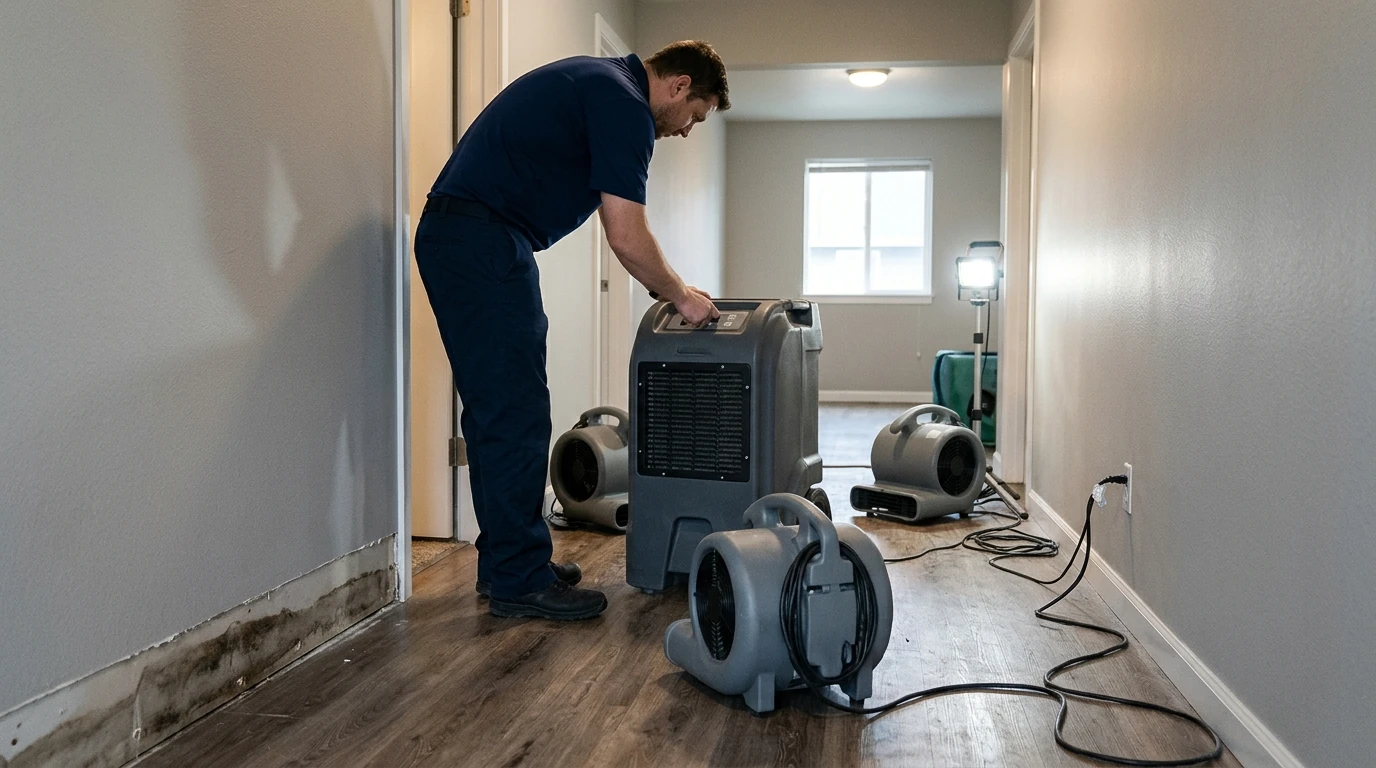
The first 24 hours are about extraction, moisture mapping, and setting equipment, not rebuilding. A restoration crew should be able to start that process the same day they’re called.
On arrival, a technician uses a moisture meter to map how far the water traveled, often further than it looks from the surface, under baseboards, inside wall cavities, beneath flooring. Standing water gets pumped or extracted first. Any material that can’t dry in place, like saturated carpet pad or swollen drywall, typically comes out at this stage rather than later, because leaving it in place slows drying and invites mold. Air movers and a dehumidifier go in to bring the space down to a dry standard, generally checked daily over the following days, following the IICRC S500 standard for water damage restoration. The Burst Pipe Emergency Checklist covers this step by step if you want the longer version.
Will insurance cover a burst pipe and the water damage in Tacoma?
Most homeowners policies cover sudden, accidental water damage from a burst pipe, but they generally exclude damage from a leak that was gradual or went unaddressed for a long time. The distinction insurers look at is whether the pipe failed suddenly or had been seeping slowly for weeks or months.
Your insurer will also expect you to mitigate further damage once the leak is stopped, which is part of why starting drying quickly matters for the claim itself, not just the repair cost. Keep your photos, the plumber’s invoice, and the restoration company’s moisture logs together; that documentation is what an adjuster asks for. The Insurance Information Institute has a plain breakdown of what standard homeowners policies typically cover, and our own guide on whether insurance covers water damage goes deeper on deductibles and what tends to get denied.
Once the plumber has the leak stopped, a written drying scope from Frontline Fire & Flood gives you the documentation an adjuster needs, and it’s the next call worth making before more of the house takes on water.