
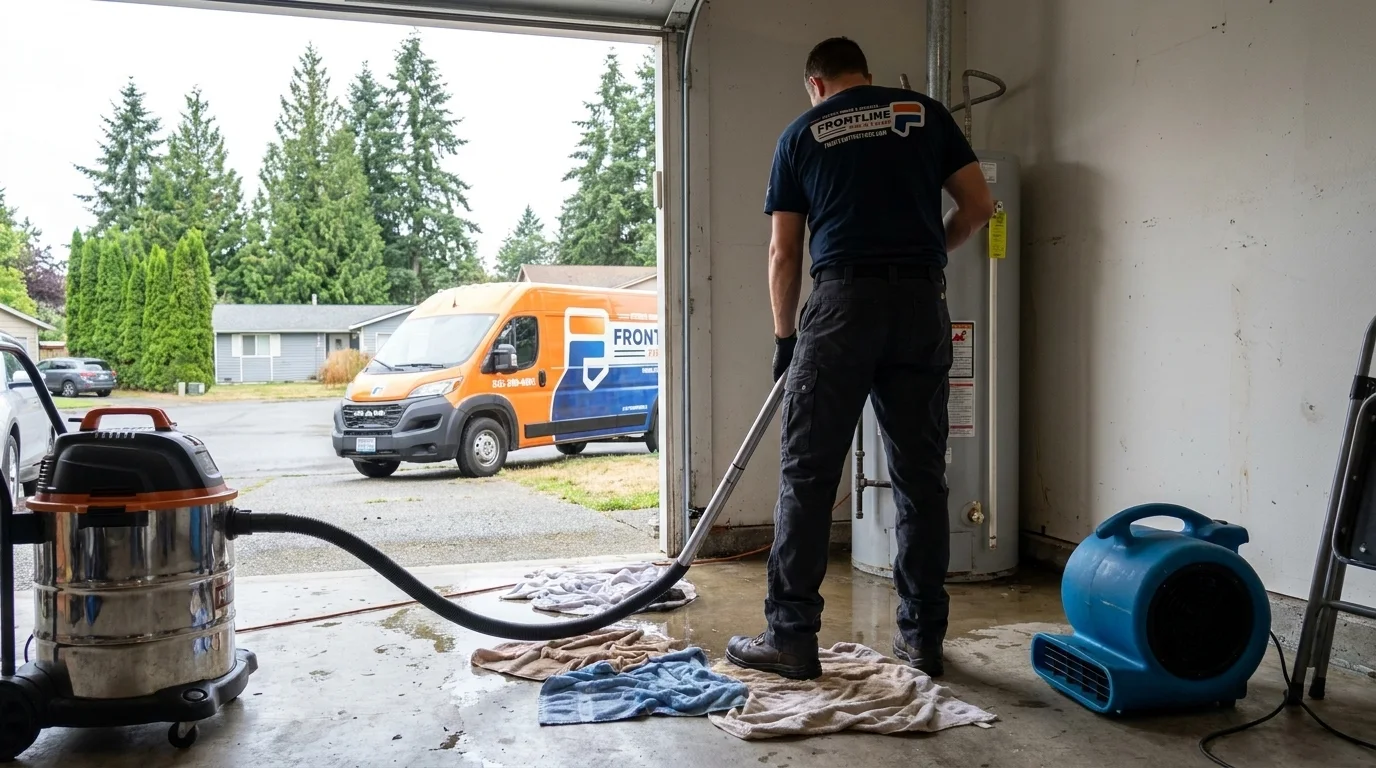
24/7 Emergency Water Heater Flood Cleanup in Lakewood
24/7 emergency water heater flood cleanup in Lakewood and surrounding areas. IICRC-certified, insurance billing accepted. Call (253) 200-0503.
Water heater flood cleanup in Lakewood? Call now, we answer 24/7. A failed water heater doesn’t always announce itself with a dramatic burst. More often it’s a slow weep from a corroded tank seam that soaks into the subfloor for days before anyone notices the soft spot near the water heater closet, or it’s a full tank failure that dumps 40 to 80 gallons across a laundry room or garage in minutes. Either way, the clock on drywall, flooring, and framing starts the moment the water hits the material, and what looks like a contained puddle is usually already tracking under baseboards and into wall cavities.
What water heater flood cleanup actually involves
A flooded water heater is a different animal depending on where the tank sits. A garage or utility closet install usually means the water pools on a slab and migrates along grout lines and expansion joints. A water heater inside a finished space, like a hall closet near bedrooms, means water can wick up drywall, saturate base plates, and get under adjacent flooring before it’s visible. We bring extraction equipment, air movers, and LGR dehumidifiers sized to the affected square footage, plus moisture meters and sometimes a thermal camera to map how far the water actually traveled versus where it looks wet on the surface.
Tank age matters too. Sediment buildup inside an aging water heater often means the water carrying minerals and light rust, which changes how we treat the affected materials even when the water itself isn’t contaminated. If the water heater sat in a space with a floor drain that backed up, or if the leak has been slow and undetected for more than 48 hours, we treat it as a higher category loss and adjust the process accordingly.
Our process
- Isolate and confirm the source. We shut off the water supply to the tank (or confirm it’s already off) and check whether the leak is from the tank itself, a supply line fitting, the pressure relief valve, or the drain pan, since that affects what we document for your claim.
- Extract standing water. Truck-mounted or portable extraction removes bulk water from flooring, carpet pad, and any pooling in low spots before it has more time to migrate.
- Map the moisture. We check subfloor, baseboards, drywall, and the base plate inside the wall cavity with a moisture meter, because water heater leaks in closets frequently wick up behind drywall even when the carpet six feet away is dry.
- Set containment and drying equipment. Air movers and dehumidifiers go in per IICRC S500 drying guidelines, with equipment placement adjusted for closets, under-sink cabinets, or any tight spaces near the tank.
- Monitor and document daily. We log moisture readings until materials reach dry standard, which is what supports your insurance claim if the adjuster asks why drywall was removed versus just dried in place.
What separates a good water heater flood response from a bad one
The most common mistake is treating a water heater leak like a simple mop-up job because the water looks clean. Clean-looking water from a tank doesn’t mean the moisture stopped at the surface. If a crew doesn’t pull baseboards or check inside the wall cavity behind the tank, trapped moisture sits there and mold can start colonizing within 24 to 48 hours in warm, enclosed spaces like a water heater closet.
Another gap: not documenting the source correctly. Insurance adjusters want to know whether this was a sudden tank failure (typically covered) or a slow leak from long-term neglect (sometimes disputed). A good response photographs the tank, the fitting or seam that failed, the water line on the walls, and the moisture readings before any drying equipment goes in, not after.
Third: under-drying tight spaces. Water heater closets and under-cabinet areas don’t get airflow the way an open room does. Air movers need to be angled correctly, and sometimes a cavity needs a small access cut to dry the wall cavity itself rather than drying the surface and hoping the inside follows.
What does water heater flood cleanup cost?
Costs vary with how far the water traveled, whether drywall or subfloor needs to come out, and whether the tank water carried sediment or rust. Every loss is different, which is why Frontline Fire & Flood provides a written scope of work before any cleanup or drying begins. Most homeowners insurance policies cover sudden and accidental water heater failures, though slow leaks tied to deferred maintenance are sometimes excluded, so documentation of the failure point matters.
| Scenario | Typical range |
|---|---|
| Contained spill, hard flooring, no drywall affected | $800 - $2,000 |
| Water heater closet with drywall and baseboard removal | $1,800 - $4,000 |
| Water tracked under adjacent flooring (laminate, carpet) | $2,500 - $6,000 |
| Undetected slow leak, subfloor and framing affected | $4,500 - $10,000+ |
| Water heater failure in finished basement or lower level | $5,000 - $12,000+ |
Seasonal & regional considerations
Lakewood’s older housing stock means a lot of water heaters are original to additions or remodels done decades ago, often tucked into tight closets with minimal clearance. Tank failures seem to cluster in colder months when incoming water temperature is lower and tanks work harder, which stresses aging seams and fittings. Homes on a crawlspace foundation, common throughout the South Sound, are also worth a closer look after a water heater leak since water can find its way down through subfloor penetrations into the crawlspace itself.
Service area
Frontline Fire & Flood handles water heater flood cleanup for homes and businesses throughout Lakewood and the surrounding South Sound area, including Tacoma, University Place, DuPont, and Steilacoom.
If your water heater has leaked, burst, or flooded a closet, garage, or finished room, don’t wait for it to look worse before calling. Schedule a moisture assessment with Frontline Fire & Flood at (253) 200-0503 and get a written scope before any drying work starts.
Frequently Asked Questions
Does homeowners insurance cover water heater flood damage?
How do I know if my water heater leak is a clean water loss or something worse?
Can drywall near the water heater be saved, or does it always need to come out?
What happens to the area while the water heater itself gets repaired or replaced?
How long does it take to dry out a space after a water heater floods it?
Looking for the best water heater flood cleanup company in Lakewood?
Frontline Fire & Flood provides licensed and insured water heater flood cleanup in Lakewood, WA and the surrounding area, and has served local property owners since 2014. Customers rate us 4.9 out of 5 stars across 137 Google reviews. We answer calls 24/7 — call (253) 200-0503 for immediate help.
Need Water Heater Flood Cleanup now?
We respond 24/7 across Lakewood and surrounding WA cities.
Related Coverage
- Our Restoration Services
- Contact Frontline Fire & Flood
- Restoration Services in Anderson Island
- Restoration Services in Auburn
- Restoration Services in Bonney Lake
- Restoration Services in Bremerton
- Restoration Services in Burien
- Restoration Services in Centralia
- Restoration Services in DuPont
- Restoration Services in Federal Way
- Restoration Services in Fife
- Restoration Services in Fircrest