
Emergency Plumbing in Lakewood
24/7 emergency plumbing in Lakewood and surrounding areas. IICRC-certified, insurance billing accepted. Call (253) 200-0503.
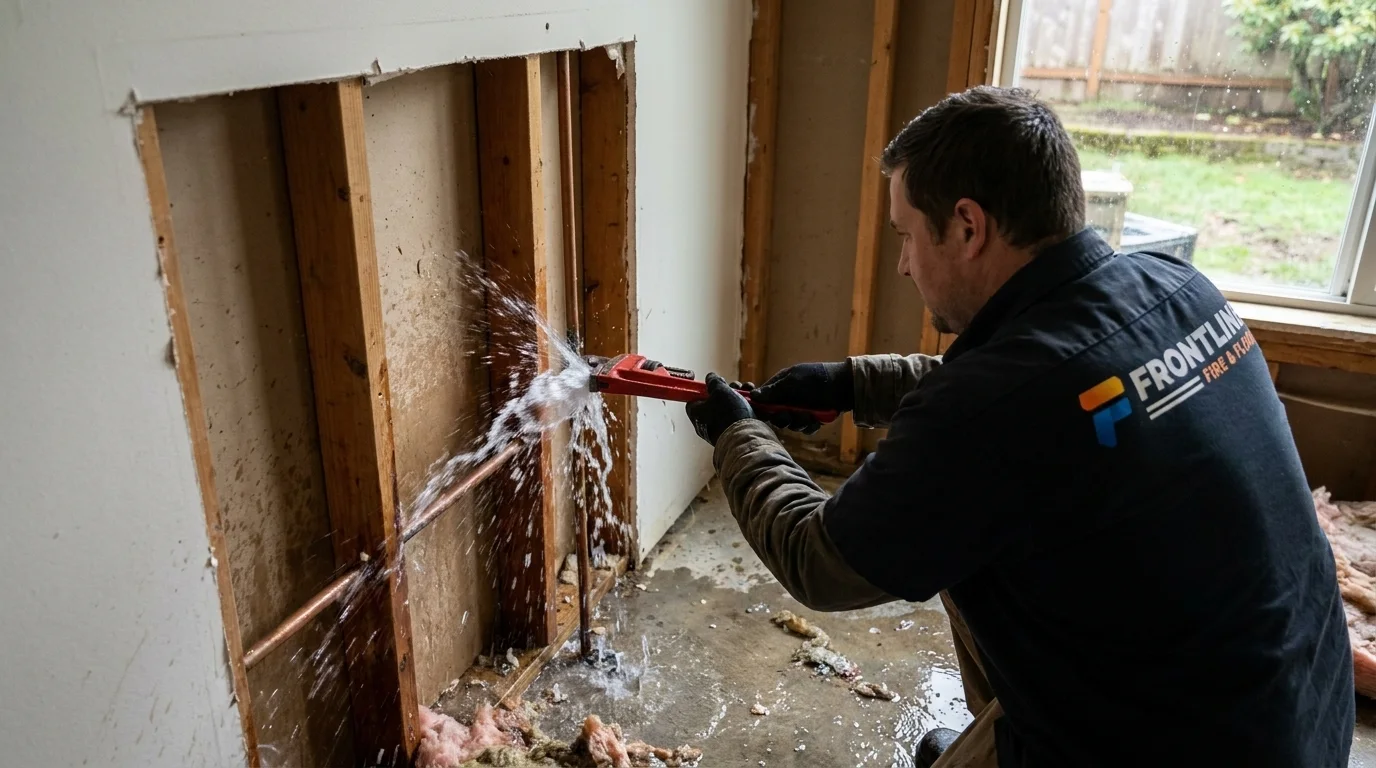
Pipe burst and water is spreading across the floor right now? Shut off the main water valve if you can reach it, then call. We answer 24/7 for emergency plumbing in Lakewood and the surrounding area, and we bring both plumbing repair and water damage mitigation to the same call so a burst pipe doesn’t turn into a mold problem three days later.
A burst or failed pipe is rarely just a plumbing issue. Once water is on the floor, under cabinets, or inside wall cavities, the clock starts on structural drying whether anyone calls it that or not. That’s the gap a standalone 24 hour plumber can leave: the leak gets stopped, but the saturated subfloor or insulation doesn’t get addressed until it’s already supporting mold growth.
What Emergency Plumbing actually involves
Emergency plumbing covers the failures that can’t wait for a Monday appointment: burst copper or PEX lines, a water heater that’s split at the tank, a main line break at the meter, a frozen and cracked supply line in a crawlspace, or a fixture supply line that lets go overnight. The work starts with locating and stopping the source, because every minute of continued flow adds gallons to what eventually has to be extracted and dried. From there it’s diagnosis: pressure testing the line, sometimes camera inspection for slab or underground leaks, and confirming whether the damage is isolated to one fixture or point to a bigger issue in the home’s plumbing age or layout. Lakewood has a lot of housing stock from the 1950s through 1980s, and homes from that era often still have original galvanized steel, or sections of polybutylene installed in the 80s, both of which fail differently than modern PEX and need to be diagnosed, not just patched.
Our process
- Phone triage. We walk you through shutting off the main or the fixture valve while we’re on the way, so active flow stops as fast as possible.
- On-site diagnosis. Pressure testing, visual inspection, and camera work where needed to find the actual failure point, not just the visible wet spot.
- Isolate and repair. Depending on the pipe material and location, that’s a cut-and-coupling repair, a full section replacement, or re-piping a run that’s failing in more than one place.
- Pressure test and restore service. Water goes back on under controlled pressure to confirm the repair holds before we leave the system live.
- Hand off to drying, if needed. When water has already reached flooring, drywall, or insulation, we document moisture levels and move straight into extraction and structural drying under the same visit, so there’s no gap between the repair and the mitigation.
What separates a good emergency plumbing response from a bad one
A rushed repair stops the leak and calls it done. A thorough one checks whether the failed section is a symptom of a bigger problem, like a water heater nearing end of life, a pressure-reducing valve that’s failed and is over-pressurizing the whole system, or galvanized pipe that’s corroding from the inside and will fail again six inches down the line. Adjusters reviewing a plumbing-related water claim look for documentation that the source was actually fixed, not just the visible damage repaired, along with moisture readings showing the affected materials were dried to a verified standard rather than just left to air out. Skipping that documentation is one of the more common reasons a claim gets questioned later.
What does Emergency Plumbing cost?
Costs vary a lot depending on pipe material, accessibility, and whether water damage mitigation is also needed, so what follows are typical industry ranges, not a quote. Every loss is different, and we provide a written scope of work before any repair begins so you know what you’re approving. Homeowners insurance typically covers the water damage caused by a sudden pipe burst, though the plumbing repair itself is often treated as a separate, non-covered maintenance cost, which is worth confirming with your carrier.
| Scenario | Typical range |
|---|---|
| Single fixture supply line repair | $150 - $450 |
| Burst pipe section repair (accessible) | $300 - $900 |
| Burst pipe in wall or crawlspace | $600 - $2,000 |
| Water heater replacement (failed tank) | $1,200 - $3,000 |
| Main line break at meter | $1,500 - $4,500 |
| Re-pipe of a failing galvanized section | $2,500 - $7,000+ |
Seasonal & regional considerations
Lakewood’s winters bring occasional hard freezes, and homes with exposed crawlspace plumbing or uninsulated exterior walls are the ones most likely to see a pipe split during a cold snap. The failure usually isn’t visible until the thaw, when the crack opens up and water starts flowing, so a sudden leak after a freeze is one of the most common calls we get this time of year. Older neighborhoods with original galvanized or early PEX installations also tend to see more pinhole leaks and fitting failures as those materials age past their expected service life.
Service area
We respond throughout Lakewood and nearby communities including Tacoma, University Place, DuPont, and the JBLM area, with plumbing repair and water damage mitigation handled by the same crew.
If water is actively flowing or you’ve got a dead water heater flooding a closet, stop reading and call. We’ll walk you through the shutoff on the phone and get a crew moving to stop the damage before it spreads further into the home.
Services We Handle
- Broken Pipes
- Burst Pipe
- Busted Pipe
- Leaking Appliances
- Leaking Pipe
- Plumbing Malfunction
- Sump Pump
- Water Leak Detection
Frequently Asked Questions
Does homeowners insurance cover emergency plumbing repairs?
What's the difference between a burst pipe repair and a full re-pipe?
How do you find a leak that's inside a wall or under a slab?
What should I do while waiting for an emergency plumber to arrive?
Why does my water heater need to be replaced instead of repaired after a leak?
Looking for the best emergency plumbing company in Lakewood?
Frontline Fire & Flood provides licensed and insured emergency plumbing in Lakewood, WA and the surrounding area, and has served local property owners since 2014. Customers rate us 4.9 out of 5 stars across 137 Google reviews. We answer calls 24/7 — call (253) 200-0503 for immediate help.
Need Emergency Plumbing now?
We respond 24/7 across Lakewood and surrounding WA cities.
Related Coverage
- Our Restoration Services
- Contact Frontline Fire & Flood
- Restoration Services in Anderson Island
- Restoration Services in Auburn
- Restoration Services in Bonney Lake
- Restoration Services in Bremerton
- Restoration Services in Burien
- Restoration Services in Centralia
- Restoration Services in DuPont
- Restoration Services in Federal Way
- Restoration Services in Fife
- Restoration Services in Fircrest