
Commercial Restoration in Lakewood
24/7 commercial restoration in Lakewood and surrounding areas. IICRC-certified, insurance billing accepted. Call (253) 200-0503.
Business flooded overnight, or smoke damage after hours? We answer 24/7 for commercial property owners and managers across Lakewood who can’t afford a storefront or office sitting closed. A burst supply line in a strip mall, a kitchen fire in a restaurant tenant space, or a sprinkler head that triggers over a weekend doesn’t wait for business hours, and neither do we.
What commercial restoration actually involves
Commercial restoration is different from a residential job mainly in scale, stakeholders, and stakes. You’re not just drying out a bedroom, you’re coordinating around tenant leases, employee schedules, inventory, server rooms, point-of-sale systems, and sometimes a property manager who answers to an owner three states away. A single water or fire event in a multi-tenant building can affect common areas, HVAC systems that serve multiple units, and drop ceilings that hide the real extent of damage until a technician pulls a tile.
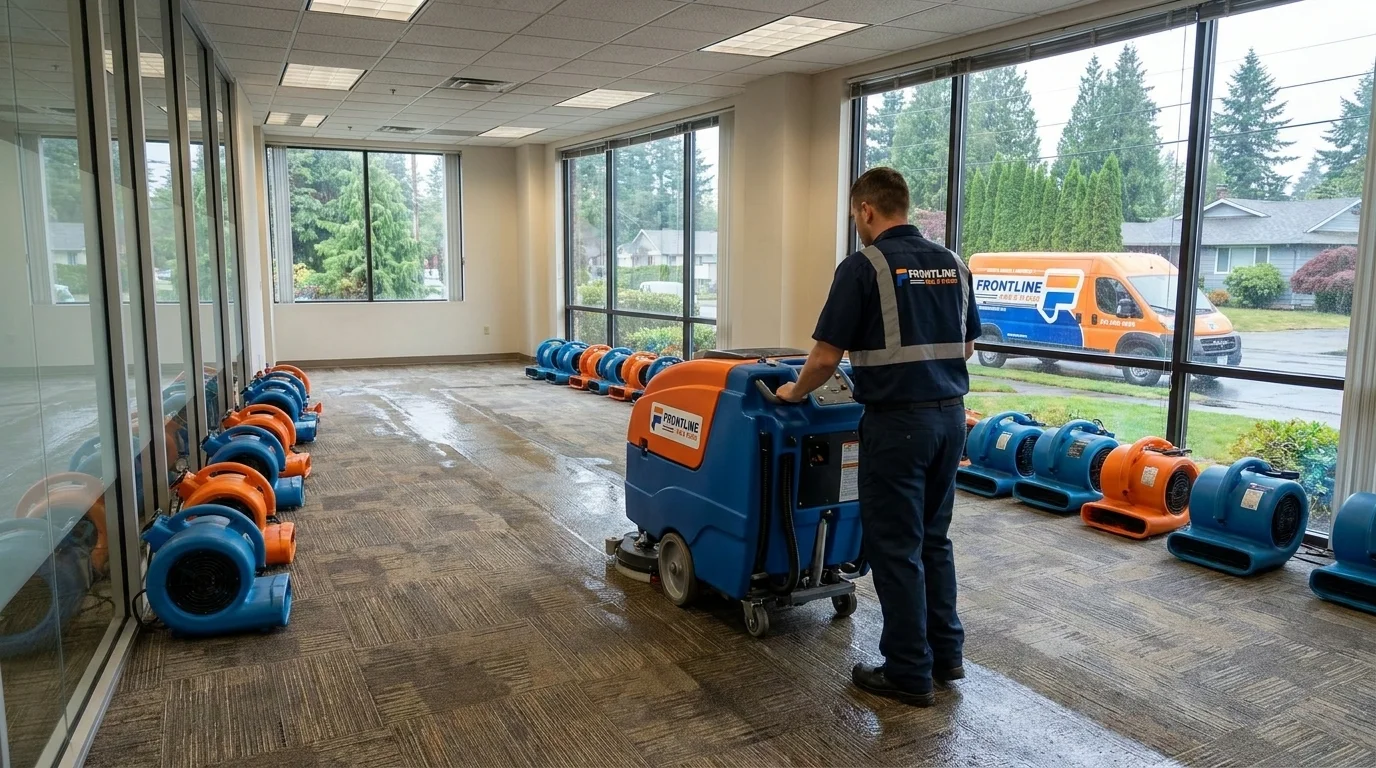
The equipment is the same category as residential work (low-grain refrigerant dehumidifiers, air movers, HEPA air scrubbers, thermal imaging cameras) but it’s deployed at commercial volume, often across larger open floor plans with raised flooring, suspended ceilings, and HVAC ductwork that needs separate attention. Timelines depend heavily on occupancy type: a vacant retail unit can be scoped faster than an operating medical office or restaurant with health code requirements layered on top of the drying standard.
Our process
- Site assessment and stakeholder coordination. We walk the affected space with the property manager or business owner, identify what’s structural versus contents, and flag anything that affects life safety (exposed wiring, compromised ceiling tile, standing water near electrical panels) before anyone else re-enters.
- Mitigation specific to the loss type. For water, that’s extraction and placement of drying equipment sized to the square footage, with moisture mapping of walls, subfloor, and any raised flooring systems. For fire or smoke, that’s soot characterization first, since protein-based residue from a kitchen fire behaves very differently than synthetic soot from burned plastics and electronics.
- Phased work to protect occupancy where possible. In a lot of commercial losses, part of the building can reopen while another section is still drying or under containment. We scope the work in zones so a retail tenant isn’t shut down any longer than the actual damaged square footage requires.
- Reconstruction and compliance check. Drywall, flooring, and finish work are scheduled once moisture readings or clearance testing confirm the space is ready, with attention to ADA and life-safety code items that commercial spaces carry and residential ones don’t.
- Documentation handoff. Photos, moisture logs, and a written scope go to the business owner and the insurance carrier, which matters more here than in a home because business interruption claims hinge on documented timelines.
What separates a good commercial response from a bad one
The most common mistake on commercial jobs is treating the whole building like one undifferentiated space instead of mapping it by tenant, lease line, and system. A crew that doesn’t check the HVAC return runs after a fire can leave soot circulating into units that looked untouched. A crew that doesn’t moisture-map under raised flooring or behind built-in casework in a retail buildout can sign off on a space that’s dry on the surface and still wet underneath, which is exactly where mold shows up three weeks later.
Adjusters on commercial claims are usually looking for the same things: dated moisture logs, photos tied to specific rooms or tenant spaces, and a scope that separates mitigation from reconstruction. A vague invoice that lumps everything together slows a claim down. Clear documentation, room by room, with equipment run-time and drying progress, moves it faster.
What does commercial restoration cost?
Commercial restoration costs vary widely based on square footage, occupancy type, and whether the loss is water, fire, or both. Typical industry figures run from a few thousand dollars for a contained single-unit water event to well into six figures for a multi-tenant fire loss requiring full reconstruction. Every loss is different, and Frontline Fire & Flood provides a written scope of work before any work begins so you know exactly what’s included.
| Scenario | Typical range |
|---|---|
| Single office suite, clean water, contained | $2,500 - $6,000 |
| Retail unit, category 2 water, flooring affected | $5,000 - $15,000 |
| Kitchen fire, single tenant space | $10,000 - $35,000 |
| Multi-tenant building, shared HVAC smoke damage | $25,000 - $75,000+ |
| Full structural fire loss, commercial reconstruction | $75,000 - $250,000+ |
Most commercial property policies cover sudden water and fire losses along with business interruption, though coverage for mold, sewer backup, or deferred-maintenance failures depends on the specific policy, so confirming with your carrier before work starts is worth the call.
Seasonal & regional considerations
Western Washington’s wet season brings a steady rise in roof leaks and storm-driven water intrusion into commercial buildings, particularly older flat-roof retail and warehouse construction common around the South Sound. Freeze events are less frequent here than inland, but when a hard freeze does hit, older commercial plumbing and unheated storage areas are the first to see pipe failures. Humidity swings through the shoulder seasons also mean any water event that isn’t dried promptly has a shorter window before secondary damage sets in.
Service area
Frontline Fire & Flood is based in Lakewood and handles commercial restoration throughout the surrounding South Sound area, including the business districts and industrial corridors nearby. If your property sits outside Lakewood proper, ask us about coverage for your specific location.
If your business has standing water, smoke odor, or fire damage right now, call (253) 200-0503 to get a crew assessing the site and a written scope started before the damage spreads to adjoining units or systems.
Frequently Asked Questions
Does commercial property insurance cover water or fire damage restoration?
How do you restore a building without shutting down the whole business?
How long does commercial water damage drying take compared to a home?
What's different about soot cleanup in a commercial kitchen fire versus an office fire?
What documentation should I keep for my business interruption claim while restoration is underway?
Looking for the best commercial restoration company in Lakewood?
Frontline Fire & Flood provides licensed and insured commercial restoration in Lakewood, WA and the surrounding area, and has served local property owners since 2014. Customers rate us 4.9 out of 5 stars across 137 Google reviews. We answer calls 24/7 — call (253) 200-0503 for immediate help.
Need Commercial Restoration now?
We respond 24/7 across Lakewood and surrounding WA cities.
Related Coverage
- Our Restoration Services
- Contact Frontline Fire & Flood
- Restoration Services in Anderson Island
- Restoration Services in Auburn
- Restoration Services in Bonney Lake
- Restoration Services in Bremerton
- Restoration Services in Burien
- Restoration Services in Centralia
- Restoration Services in DuPont
- Restoration Services in Federal Way
- Restoration Services in Fife
- Restoration Services in Fircrest