
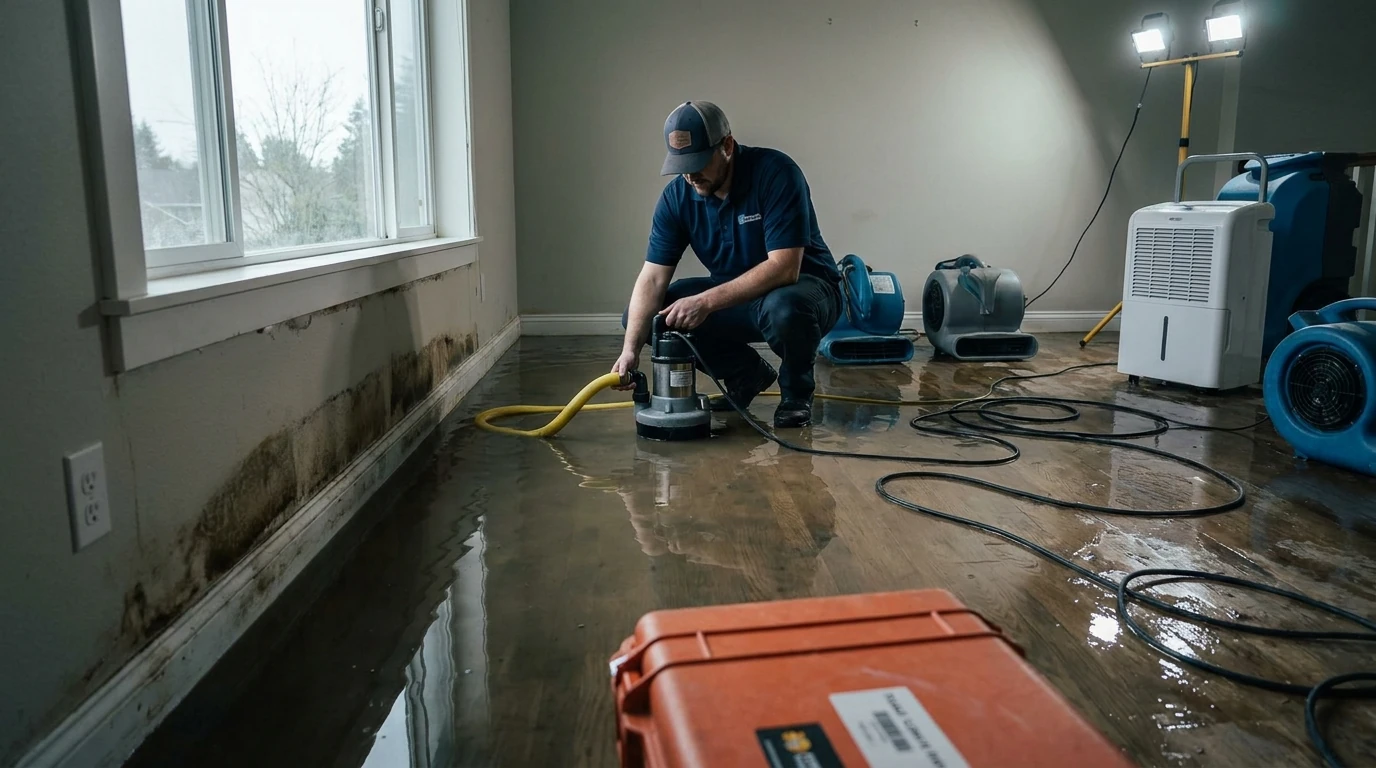
TL;DR: In Washington State, water damage restoration typically costs $1,500 to $12,000 for most residential losses. Small, clean-water jobs (a burst supply line caught quickly in a single room) run $1,200 to $3,500. Large losses involving multiple floors, contaminated water, or structural materials push into the $8,000 to $20,000+ range. The single biggest cost driver is how fast you respond: every hour standing water sits, the damage category climbs and the bill grows.
If you just discovered water in your home and you’re trying to figure out what this is going to cost before you call anyone, this guide gives you real numbers. Not ballpark guesses. The ranges below reflect the actual scope of work involved in drying, cleaning, and restoring a Washington home to pre-loss condition, per IICRC S500 Standard for Professional Water Damage Restoration.
How Much Does Water Damage Restoration Cost in Washington State?
Most Washington homeowners pay between $3,000 and $8,000 for water damage restoration, with the full range running from $1,200 for a minor single-room loss to $25,000 or more for a Category 3 (sewage or floodwater) event affecting multiple floors.
The table below breaks down typical costs by scenario:
| Scenario | Typical Cost Range |
|---|---|
| Single room, clean water (Cat 1), caught within 24 hours | $1,200 - $3,500 |
| Two to three rooms, clean or gray water (Cat 1-2), hardwood or carpet affected | $3,500 - $7,500 |
| Finished basement, clean water, drywall and flooring removal needed | $4,000 - $9,000 |
| Multiple floors, gray water (Cat 2), appliance or supply line failure | $6,000 - $14,000 |
| Whole-floor or whole-home loss, Category 3 (sewage, floodwater) | $10,000 - $25,000+ |
| Crawl space flooding with insulation and vapor barrier replacement | $2,500 - $8,000 |
These are industry-typical ranges for the Pacific Northwest market. Every loss is different, and a written scope of work from a certified restoration company is the only reliable way to price your specific situation.
What Factors Move the Cost Up or Down?
Five variables account for most of the spread between a $1,500 job and a $15,000 job.
Water category. The IICRC classifies water in three categories. Category 1 is clean water from a supply line or appliance. Category 2 (gray water) carries contaminants from dishwashers, washing machines, or toilet overflow without solids. Category 3 (black water) includes sewage, floodwater, or any water that has sat long enough to become grossly contaminated. Cat 3 jobs require full PPE, antimicrobial treatment, and disposal of porous materials that cannot be safely dried in place. That adds significant labor and material cost.
Water class (how far it spread). Class 1 means water affected a small area with low-porosity materials. Class 4 means water soaked into hardwood, concrete, or plaster and requires specialty drying equipment and longer dry times. A Class 4 loss in a home with old-growth fir floors can run two to three times the cost of a Class 1 loss in the same square footage.
Response time. Wet drywall that is extracted and dried within 24-48 hours can often be saved. Drywall that has been wet for 72 hours or more typically needs to come out. Same principle applies to subfloor, insulation, and framing. Every day of delay converts a drying job into a demolition-and-rebuild job.
Affected materials. Tile and concrete dry faster and cheaper than hardwood, engineered wood, or carpet over pad. Homes with older construction (pre-1980s Lakewood bungalows near Steilacoom Lake, for example) may have plaster walls, old-growth lumber, or asbestos-containing materials that require specialized handling before drying work can begin.
Reconstruction scope. Mitigation (drying and cleaning) is separate from reconstruction (replacing what came out). If drywall, flooring, or cabinetry has to go, that work is priced separately. A $5,000 mitigation job can come with a $6,000 reconstruction estimate on top of it.
Will Homeowners Insurance Cover Water Damage Restoration in Washington?
Most standard homeowners policies in Washington cover sudden, accidental water damage but exclude gradual leaks and flood events. Whether your claim gets approved depends heavily on the cause of loss and how well it is documented.
Policies typically cover:
- Burst pipes (sudden failure, not deferred maintenance)
- Appliance failures (washing machine hose, dishwasher supply line)
- Overflow from a toilet or tub (accidental)
- Roof leak from a covered storm event
Policies typically exclude:
- Gradual leaks (a slow drip behind a wall that went undetected for months)
- Flooding from surface water or storm surge (requires a separate NFIP or private flood policy)
- Sewer backup (often excluded unless you have a specific rider)
- Damage from deferred maintenance
For more detail on what Washington policies actually pay out, see our guide on does homeowners insurance cover water damage.
The documentation that protects your claim: photos and video of the damage before anything is moved, a written moisture map from a certified technician, and a detailed scope of work tied to line-item pricing. Adjusters work from documentation. A restoration company that provides a thorough written scope from day one makes the claims process significantly smoother.
One practical note: your deductible applies before the policy pays anything. Washington homeowners with $2,500 or $5,000 deductibles on smaller losses may find the out-of-pocket cost is close to the total job cost. It is worth knowing your deductible before you file, because filing a claim that does not result in a payout can still affect your renewal rate.
For guidance on whether to file at all, the Washington State Office of the Insurance Commissioner has plain-language resources on homeowners policy rights.
What Happens During Water Damage Restoration? (Step by Step)
Understanding the process helps you evaluate a scope of work and know whether a contractor is cutting corners.
-
Emergency extraction. Standing water is removed first using truck-mounted or portable extractors. This step is measured in gallons per hour and happens before any drying equipment is placed.
-
Moisture mapping. A technician uses a non-penetrating moisture meter and thermal imaging to document exactly where water migrated. This map becomes the baseline for drying goals and the insurance claim.
-
Controlled demolition (if needed). Wet drywall, insulation, and flooring that cannot be dried in place are removed. This is called “flood cuts” for drywall (typically 12-18 inches above the waterline) and is done to expose the structural cavity for drying.
-
Drying equipment placement. LGR (low-grain refrigerant) dehumidifiers and high-velocity air movers are placed in a calculated configuration based on the affected square footage and material types. The IICRC S500 standard defines the equipment ratios required for each class of loss.
-
Daily monitoring. A technician returns each day to read moisture levels and adjust equipment. Drying typically takes 3 to 5 days for Class 1-2 losses, longer for Class 3-4.
-
Antimicrobial treatment. Applied to any area with elevated microbial risk, especially Category 2 or 3 losses. This is not the same as mold remediation, which is a separate scope if mold growth is confirmed.
-
Final clearance readings. Moisture levels are documented at or below the target dry standard before equipment is removed. A reputable company provides you with a drying log you can give to your adjuster.
-
Reconstruction. Once the structure is dry and cleared, the rebuild phase begins: new drywall, flooring, paint, and any cabinetry or fixtures that were removed.
For a step-by-step guide to what you should do in the first 24 hours before a crew arrives, see what to do in the first 24 hours after water damage.
What Should You Do Right Now?
If water is still present, your first call is to stop the source. Shut off the main water supply if a pipe or appliance is the cause. If the water involves electrical panels, outlets, or wiring, leave the area and call your utility before re-entering. The EPA’s guidance on flood cleanup covers the health risks of standing water and when to involve professionals.
Once the source is controlled, call a certified restoration company. The longer water sits in a Pacific Northwest home (where ambient humidity is already high), the faster secondary damage compounds. Mold can begin colonizing wet building materials in as little as 48 to 72 hours under the right conditions.
Frontline Fire & Flood is an IICRC-certified firm serving Lakewood and the surrounding South Sound region, available 24/7 at (253) 200-0503. They provide a written scope of work before any restoration begins, and their technicians handle the documentation your insurance adjuster will need.
If you are comparing restoration companies in the area, the best water damage restoration companies in Lakewood post covers what to look for and who operates locally.
About Frontline Fire & Flood
Frontline Fire & Flood is an IICRC-certified restoration firm based in Lakewood, WA, serving the South Sound and greater Puget Sound region since 2014 (license CCFRONTFF761CB). Their certified technicians hold IICRC credentials in Water Damage Restoration (WRT), Structural Drying (ASD), Mold Remediation (AMRT), and Fire and Smoke Restoration (FSRT). Services include water damage restoration, water cleanup, fire damage restoration, mold remediation, storm damage restoration, sewage cleanup, asbestos abatement, emergency board-up and tarping, and contents restoration and storage. Available 24/7.
Video Transcript
Just found water in your home and wondering what it’s going to cost? Here are the real numbers for Washington State homeowners in 2026. Most Washington homeowners pay between three thousand and eight thousand dollars. Smaller single-room jobs start around twelve hundred. Large losses, multiple floors, sewage, or floodwater, can reach twenty-five thousand dollars or more. The single biggest cost driver is how fast you respond. Standing water gets more expensive every single hour. Water is classified in three categories. Clean supply-line water is cheapest. Sewage or floodwater requires full protective gear and disposal of porous materials. How far the water spread matters too. Hardwood floors soaked for days cost two to three times more to dry than tile in the same square footage. Drying is separate from rebuilding. A five-thousand-dollar dry-out can come with a six-thousand-dollar reconstruction estimate on top. Homeowners insurance usually covers sudden accidents like burst pipes or appliance failures, but not slow leaks, flooding, or deferred maintenance. Document everything before moving anything. Photos, video, and a written moisture report from a certified technician protect your insurance claim. Get accurate numbers fast. Call Frontline Fire and Flood at two-five-three, two-hundred, zero-five-zero-three for a free estimate.