
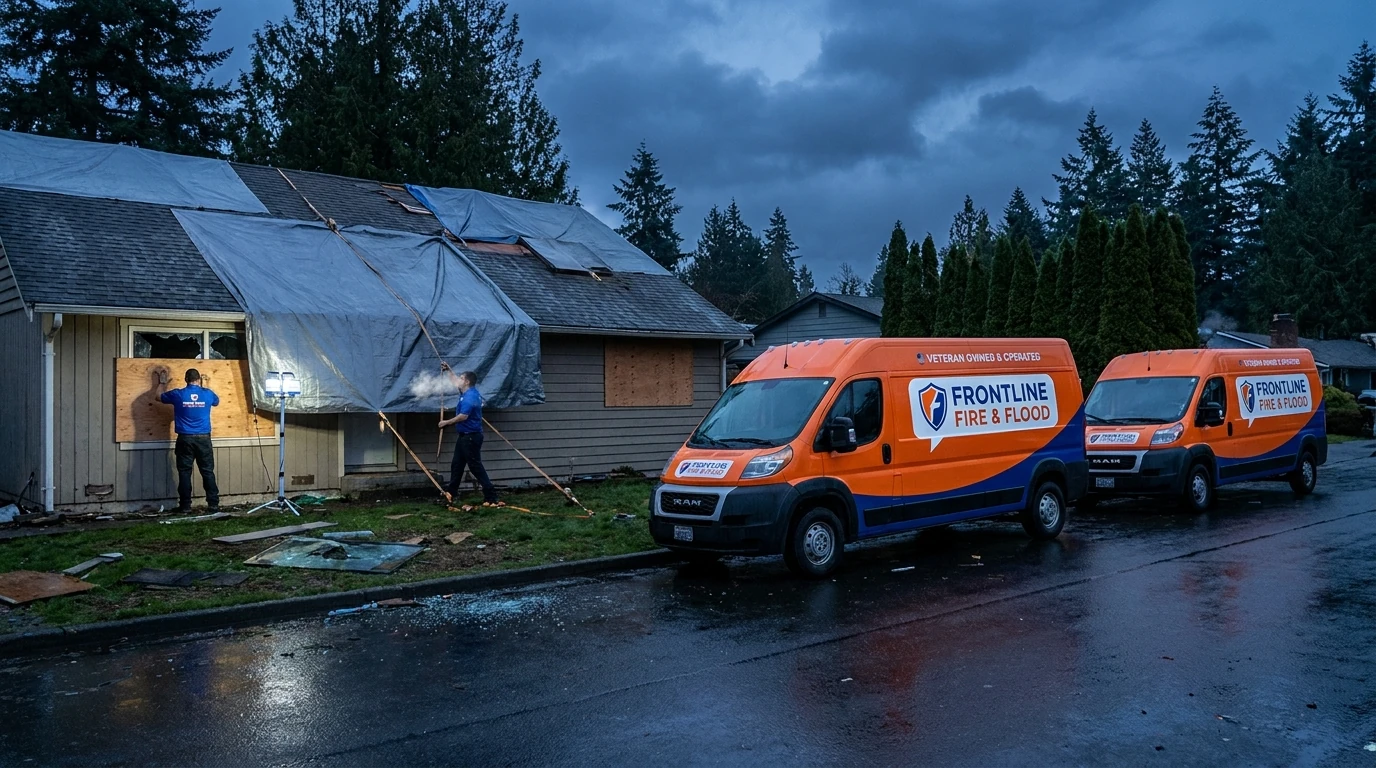
TL;DR: Board-up and tarping services secure a damaged property immediately after a fire, storm, break-in, or structural failure. A crew installs plywood over broken windows and doors, and heavy-duty poly tarps over compromised roof sections, stopping weather, theft, and secondary damage before restoration begins. In Parkland, WA, where fall rain arrives fast and properties can sit exposed overnight, getting a crew on-site within hours is the difference between a contained loss and a much larger one.
If your property just took a hit, a house fire, a windstorm that peeled back roofing, a break-in that shattered a window, the structure is open right now. Every hour it stays open, rain, wind, and opportunistic entry compound the damage. Board-up and tarping is not a restoration step; it is a damage-control step that happens first, before any drying, cleaning, or rebuilding begins. Here is what the service actually involves, when you need it, and how it connects to your insurance claim.
What do board-up and tarping services actually cover?
Emergency board-up and tarping covers any opening in a structure that is exposing the interior to weather, intrusion, or further damage. That means broken windows from a fire or a break-in, compromised entry doors, garage doors that failed during a storm, and roof sections where shingles, decking, or structural members have been displaced. The crew assesses every opening, measures and cuts plywood panels to fit window and door frames, and secures them with screws into the surrounding framing, not just taped plastic. Roof tarps are heavy-duty polyethylene, anchored with lumber battens and screwed into solid decking, not just draped and hoped for the best.
In Parkland and the surrounding South Pierce County area, common triggers include:
- House fires that burn through roof decking or blow out windows from heat and pressure
- Windstorm damage, the Pacific Northwest’s fall and winter wind events regularly strip shingles and lift sections of older roofing
- Break-ins that leave shattered glass in doors and windows
- Vehicle impacts on garage doors or exterior walls
- Structural failures from water-saturated roof decking or deferred maintenance that finally gives way
The Pacific Lutheran University corridor and the older residential blocks near Parkland’s 112th Street area have a mix of housing stock from the 1950s through the 1980s. Older roofing systems and single-pane windows are more vulnerable to both storm damage and fire spread, which means board-up needs tend to be more extensive when they happen.
When does a property actually need emergency board-up?
A property needs emergency board-up any time an opening exists that cannot be secured by normal means before the structure is left unattended. If a fire burned through a wall or roof, if a window is broken and cannot be relocked, or if a door frame is compromised, the property needs board-up that night. Waiting until morning is almost never the right call in the Pacific Northwest, where overnight rain is a near-certainty from September through May.
Insurance adjusters also expect to see mitigation steps taken promptly. Most homeowners and commercial property policies include a “duties after loss” clause that requires the policyholder to protect the property from further damage after a covered event. Failing to board up a fire-damaged structure and then filing a claim for rain damage that entered through the burned roof is a common reason secondary damage claims get disputed. Documenting the board-up, photos before, photos after, a written scope from the contractor, protects the claim.
Frontline Fire & Flood operates 24/7 and responds to emergency board-up calls across Parkland and the broader Pierce County area. Their crews are IICRC-certified and carry the documentation insurers expect: written scope of work, before-and-after photos, and itemized material lists.
What does the board-up process look like, step by step?
A professional board-up follows a consistent sequence regardless of the damage type.
- Site assessment. The crew walks the entire perimeter and interior (where safe) to identify every compromised opening. They note structural hazards, weakened floors, unstable walls, live electrical, and flag areas that require caution during the work.
- Measurement and material staging. Plywood is cut to fit each opening. Standard is 5/8” OSB or plywood for windows and doors; heavier material for larger openings. Roof tarp material is selected based on the size of the affected area.
- Window and door boarding. Panels are screwed into the surrounding framing, not just the window casing. This matters, a panel screwed only into the casing can be kicked in. Proper installation anchors into structural members.
- Roof tarping. Tarps are laid over the damaged section with overlap onto undamaged roofing. Lumber battens are screwed through the tarp into solid decking every 18-24 inches. Ridge caps and edges are secured to prevent wind uplift.
- Documentation. Photos of every opening before and after, a written inventory of materials used, and a signed scope of work. This package goes directly to the property owner and can be forwarded to the insurance adjuster.
- Coordination with restoration. Board-up is the first step, not the last. Once the structure is secured, the restoration assessment begins, water extraction, fire damage evaluation, or structural drying, depending on what caused the damage.
For fire-affected properties, the board-up crew coordinates with the fire damage restoration team. For storm-damaged properties, they work alongside the storm damage restoration assessment. The goal is a single, documented chain of custody from emergency securing through full restoration.
How does board-up connect to your insurance claim?
Emergency board-up and tarping costs are almost always covered under a standard homeowners or commercial property policy as part of the “mitigation” or “protective measures” coverage. This is separate from the main dwelling or structure coverage and typically does not draw against your deductible. The insurer pays for reasonable steps taken to prevent further loss.
The key word is “reasonable” and the key requirement is documentation. An adjuster reviewing a board-up claim wants to see: what was open, what was done to close it, what materials were used, and what it cost. A contractor who provides a written scope with photos satisfies that requirement. A property owner who staples plastic sheeting over a broken window and submits a receipt for a roll of poly does not.
If you have already called your insurance company and they have assigned an adjuster, the board-up contractor can communicate directly with the adjuster’s office to provide documentation. If you have not yet called your insurer, the board-up can happen first, in fact, it should. Mitigation is your obligation under the policy; the claim call can follow once the property is secured.
For more on how insurance interacts with restoration work, the post on does homeowners insurance cover water damage covers the documentation and claim process in detail, the same principles apply to fire and storm claims.
If you are also dealing with fire damage beyond the board-up, the fire damage restoration process explains what comes next once the structure is secured.
What should you do right now if your property is open?
Call a 24/7 emergency board-up service before you do anything else. Do not wait for the insurance adjuster to authorize the work, authorization is not required for emergency mitigation, and waiting costs you. Do not attempt to board up a fire-damaged structure yourself if there is any question about structural stability or air quality; post-fire interiors have particulate hazards that require respiratory protection.
While you wait for the crew, take your own photos of every opening from a safe distance. Note the time and date. If the damage was caused by a fire, get the fire department incident report number, you will need it for the claim.
Frontline Fire & Flood handles emergency board-up and tarping across Parkland, Spanaway, Tacoma, and the surrounding South Pierce County area, 24 hours a day. Call (253) 200-0503 to get a crew dispatched.
About Frontline Fire & Flood
Frontline Fire & Flood is an IICRC-certified firm serving Parkland, Lakewood, Tacoma, and the greater Pierce County area since 2014 (license CCFRONTFF761CB). The company is licensed, insured, and locally owned, with certified crews handling water damage restoration, fire damage restoration, mold remediation, storm damage restoration, sewage cleanup, asbestos abatement, emergency board-up and tarping, and contents restoration and storage. They operate 24/7 for emergency response across South Pierce and King counties.
Video Transcript
Your property just took serious damage, fire, storm, or break-in. Right now it’s wide open to rain, wind, and theft. Every hour counts. Board-up and tarping is damage control, it happens before any cleaning or rebuilding. It stops the bleeding so restoration can actually begin. A crew boards every broken window and door with thick plywood screwed into the structural framing, not just taped plastic that fails overnight. For damaged roofs, heavy-duty poly tarps go on immediately, anchored with lumber battens and screws into solid decking to handle real wind. In Parkland, fall rain arrives fast. Leaving a fire or storm-damaged structure open overnight almost always means a bigger, more expensive repair. Your insurance policy likely requires you to protect the property right away. Skipping board-up can cause secondary damage claims to get denied. Every job is fully documented, before and after photos, a written scope, and an itemized material list, everything your adjuster needs. Board-up connects directly to your full restoration, water extraction, fire damage cleanup, or structural drying starts right after the property is secured. Frontline Fire and Flood responds 24 hours a day across Parkland and all of Pierce County, crews are IICRC-certified and ready around the clock. Don’t wait until morning. Call Frontline Fire and Flood at 253-200-0503 for a free estimate and get a crew to your property tonight.