
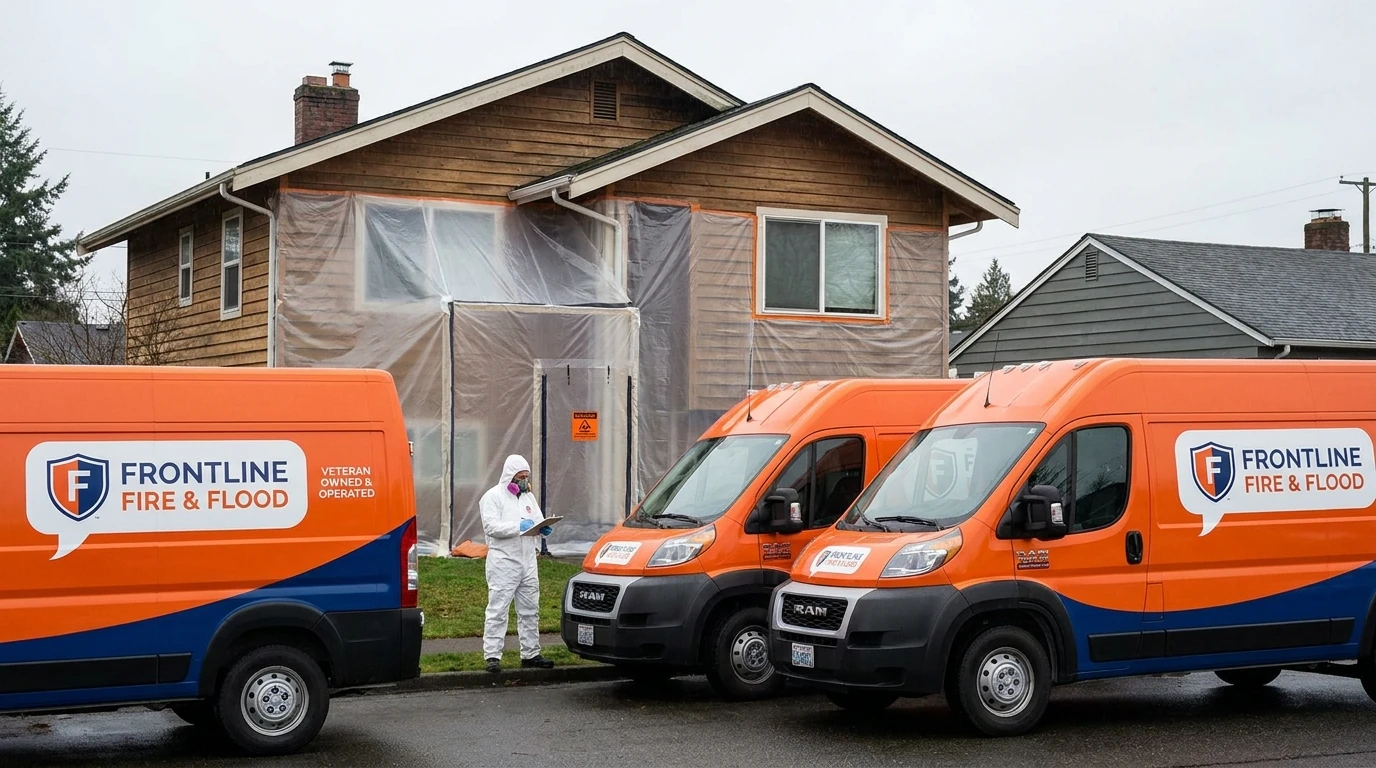
TL;DR: Asbestos and lead abatement in Olympia, WA involves testing, containment, licensed removal, and air clearance testing by a certified contractor. Homes and commercial buildings built before 1980 are the most likely to contain these hazards. Washington State requires licensed abatement contractors for regulated work, and disturbing these materials without proper controls creates serious health and legal liability. If you’re planning a renovation, responding to damage, or buying an older property near downtown Olympia or the South Capitol neighborhood, get a professional assessment before any demolition or repair work begins.
You’re looking at a 1960s craftsman in Olympia’s Eastside neighborhood, or maybe a commercial building near the Port of Olympia, and someone just mentioned the words “asbestos” or “lead paint.” Now you need to know what that actually means for your project, your timeline, and your budget. This post gives you the straight answer on what these hazards are, when abatement is legally required, what the process looks like, and what to ask before you hire anyone.
What Are Asbestos and Lead, and Why Do They Matter in Olympia?
Asbestos is a naturally occurring mineral fiber that was widely used in building materials from the 1940s through the late 1970s. Lead was a common additive in paint until the EPA banned residential use in 1978. Both are still present in a large portion of Olympia’s older housing stock, particularly in the historic neighborhoods around Bigelow and the Capitol Campus area where many homes date to the 1940s through 1970s.
Asbestos becomes dangerous when it is disturbed. Intact floor tiles, pipe insulation, or ceiling texture that is in good condition may pose little immediate risk. But sanding, cutting, or demolishing these materials releases microscopic fibers that, when inhaled, can cause mesothelioma, asbestosis, and lung cancer. These diseases often take 20 to 40 years to develop, which is why the hazard is easy to underestimate.
Lead paint is a different mechanism but equally serious. Deteriorating lead paint produces dust and chips that children and adults can ingest or inhale. Lead exposure causes neurological damage, particularly in children under six. Washington’s Puget Sound region has tens of thousands of pre-1978 homes, and Olympia’s older residential core is no exception.
The EPA’s asbestos and lead information pages are the authoritative source for health effects and regulatory background.
When Is Abatement Legally Required in Washington State?
Abatement is required by law in specific situations, not every time these materials are found. Washington State’s Department of Labor and Industries (L&I) and the Department of Ecology regulate asbestos abatement under WAC 296-62-07705 and related rules. Here is when you are required to use a licensed abatement contractor:
- Renovation or demolition of a structure that contains regulated asbestos-containing material (RACM). The threshold for commercial and public buildings is 260 linear feet or 160 square feet of material. For residential properties, any regulated work must be done by a licensed contractor.
- Damaged or friable asbestos, meaning material that can be crumbled by hand pressure, must be addressed regardless of quantity.
- Any renovation that disturbs lead-based paint in pre-1978 housing requires compliance with the EPA’s Renovation, Repair, and Painting (RRP) Rule. Contractors must be EPA Lead-Safe Certified to perform this work.
- Real estate transactions often trigger inspection requirements, especially for commercial properties or multi-family buildings.
For homeowners doing their own work in their own single-family residence, some exemptions apply, but those exemptions do not extend to contractors you hire. Any contractor you bring in must hold the appropriate Washington State certification.
What Does the Abatement Process Actually Look Like?
Professional asbestos and lead abatement follows a defined sequence. Knowing the steps helps you evaluate bids and understand what you’re paying for.
1. Inspection and sampling. A certified inspector collects samples of suspected materials and sends them to an accredited laboratory. Results typically come back within 24 to 72 hours. Do not skip this step and assume based on the age of the building alone.
2. Written abatement plan. The contractor develops a scope of work that identifies the materials to be removed, the containment method, the disposal plan, and the air monitoring protocol. Washington State requires this documentation.
3. Containment setup. Workers seal the work area with poly sheeting and establish negative air pressure using HEPA-filtered exhaust fans. This prevents fibers or dust from migrating to clean areas of the building. For asbestos work, workers wear full Tyvek suits with hoods and P100 respirators with a full face seal. This is not optional PPE.
4. Removal and packaging. Asbestos materials are wet-wiped or wet-removed to suppress fibers, then double-bagged in labeled, sealed 6-mil poly bags. Lead paint removal may involve wet scraping, chemical stripping, or HEPA vacuum sanding, depending on the scope.
5. Disposal. Asbestos waste is transported to a licensed disposal facility. In Washington, this must be a permitted Class I or Class II landfill that accepts asbestos. The contractor provides a waste manifest.
6. Air clearance testing. After removal and cleanup, an independent industrial hygienist (not the abatement contractor) collects air samples. The area is not cleared for re-occupancy until fiber counts fall below the regulatory threshold. This final step is what separates legitimate abatement from a crew that just pulls material and leaves.
For lead abatement, post-clearance includes dust wipe sampling analyzed by an accredited lab, following EPA protocols.
How Does Abatement Interact With a Damage Claim or Restoration Project?
This is where Olympia property owners often get caught off guard. If you have a water loss, fire, or storm event in a pre-1978 building, the restoration contractor cannot simply begin demolition. Washington State requires testing before any regulated demolition in structures of that age, and your insurance adjuster will expect documentation.
Most homeowners’ policies cover the cost of abatement when it is required as part of a covered loss, but the coverage language varies. Some policies cover abatement only if the hazardous material was directly damaged by the covered peril. Others exclude it entirely. Read your declarations page carefully, and ask your adjuster specifically about “pollutant” exclusions, which some carriers use to deny asbestos and lead claims.
If you’re managing a restoration project in Olympia that involves a pre-1978 structure, Frontline Fire & Flood holds EPA Lead-Safe Certification and OSHA training, and can coordinate the abatement scope alongside the broader restoration work so you’re not managing two separate contractors and two separate timelines.
For more on how insurance intersects with restoration work, see Does Homeowners Insurance Cover Water Damage? and How To Choose a Restoration Company.
What Should You Ask Before Hiring an Abatement Contractor?
Not every contractor who offers to “take care of” asbestos or lead is licensed to do so legally. Before you sign anything, ask these specific questions:
- Are you licensed by Washington State L&I for asbestos abatement? Ask for the license number and verify it at the L&I contractor lookup.
- Are you EPA Lead-Safe Certified? Required for any pre-1978 renovation work.
- Who performs the post-clearance air testing? It should be an independent industrial hygienist, not the abatement firm itself.
- What is your waste disposal plan, and can you provide the manifest? Legitimate contractors document this without hesitation.
- Do you carry liability insurance and workers’ compensation? Abatement contractors working without coverage create liability that can land on the property owner.
A contractor who hesitates on any of these questions is a contractor to avoid. The health consequences of improperly handled asbestos or lead are permanent.
What to Do Right Now
If you suspect asbestos or lead in your Olympia property, the first step is straightforward: do not disturb the material, and schedule a professional inspection. Do not sand, drill, or demolish anything in the affected area until you have lab results.
If you are in the middle of a renovation or restoration project and you’ve just discovered a potential hazard, stop work in that area immediately. Continuing without assessment creates liability and, more importantly, health risk for everyone on site.
For Olympia properties, a written abatement scope from a licensed contractor is the document that protects you with your insurer, your future buyers, and Washington State regulators. Get it in writing before any work begins.
About Frontline Fire & Flood
Frontline Fire & Flood is an IICRC-certified firm serving Olympia, Lacey, Tumwater, and the greater South Sound region since 2014 (license CCFRONTFF761CB). The company holds IICRC certifications in water damage restoration, structural drying, mold remediation, and fire and smoke restoration, along with EPA Lead-Safe Certification and OSHA training. Services include asbestos abatement, water damage restoration, fire damage restoration, mold remediation, sewage cleanup, storm damage restoration, and emergency board-up and tarping.